In the United States, Korean organizations with public personality are mediating between the Korean residents and the state government, as well as between Korean government, while receiving subsidies from the provincial government. In order to investigate such activities, we conducted an interview survey for 15 days from September 6, 2017 in each suburb of Washington, DC, New York, Boston, and Los Angeles.
The survey is divided into four categories:
(1) Growing influence of Koreans in the United States
Photo is Director Kim Ji-su
George Washington University Korean Studies Center, the MISTI Korea Program at Massachusetts Institute of Technology, and Korean Towns in various places were investigated respectively.
George Washington University Korean Studies Institute opened in January 2017. The work content of the institute is human exchanges, research, setting up lecture curriculum of students, etc. For fiscal year 2017, it have opened four courses such as Korean art history and North Korean history, and a lecturer is a researcher belonging to the Institute for Space Policy Research that are familiar with the trend of North Korea. Students are particularly interested in North Korea, and more than 200 people wish to attend North Korean history course. Kim Ji-su said that the global influence of Hallyu (Korean-style culture) cannot be ignored as a reason why domestic and international students’ interest in Korea is high.
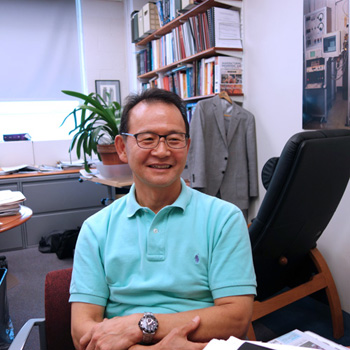
Photo : Professor Jeong Jung Hoon(Faculty Director)
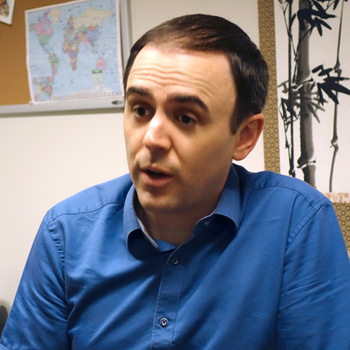
Photo : Mr. Matt Burt
MIT International Science and Technology Initiatives (MISTI) of Massachusetts Institute of Technology (MIT) manages internship programs for companies all over the world. The MISTI Korea program was established in 2012. This program is managed by Professor Jung Jung Hoon (Faculty Director) and Mr. Matt Burt (Managing Director).
South Korean host companies are aggressive in accepting MIT students. One company has set up an internship program and supports financial resources. Another company accepts internship from a long-term perspective, and in some cases, solves various problems through negotiation, and hires the student after the internship is over. However, sometimes it may not match the student's intention. A company focused on short-term interests, letting students leaves important tasks to the students.
Another thing that has attracted attention in the Korea program is the “Global Teaching Lab.” The purpose of the program is to make MIT students deepen their interests and knowledge through teaching themselves. This program is intended for children in the hierarchy in need of support. They have limited opportunities for extra-curricular lessons due to parents' low incomes or the absence of parents. MIT is responsible for the students dispatching cost.
Photo : Korea Town of Boston
There are Korean towns in various places in America. In each area, statues of historical figures related to the area are set up. In the survey I visited Korea Town of Boston (picture), New York City (picture: New York Korea town entrance), New Jersey (picture), Flushing, New York (picture), and Los Angeles (picture). With the exception of Korean town in Boston and New Jersey, stores are on a scale well enough for the Korean Americans to live.
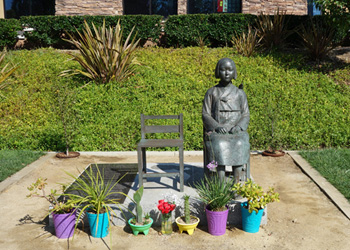
Photo : The Statue of Peace in Glendale Central Park
Also, there are Korean societies in various places. They are active with the aim of opposition against DACA (Deferred Action for Childhood Arrivals) abolition, support for renegotiation of Korea-US FTA, and growth of political power of next generation Koreans. In September 2017 it was newly established in Rhode Island and in New Hampshire. However, the Boston Korean association(Society?) has been suspended from last year. It seems that Korean community activities do not make much sense to Koreans in areas where there are many people with communities that can belong to other than the Korean community.
Photo is Ann Chan-ho statue
In the building of New York Korean Society, the Korean immigration history museum (MOKHA, Museum of Korean American Heritage) is preparing to open. Exhibition of history from the beginning of immigration, war, independence movement, and Korean culture is scheduled. A Statue of Peace was also set up here. There are six places in the United States where the Statue of Peace are set up.
Photo : Mr. Yoon Young-jae
Photo : Takeshima (Dokdo in Korea)
There are also statues of historical figures that are related to America in various places. There is the statue of Ann Chang-ho in Riverside, California.There is So Jepil Memorial Hall in Philadelphia. Also, activities such as Baekbeom Kim Gu Memorial Association, Korean Patriot AHN Jung-Geun Memorial Association, are also being developed mainly in the Korean community who emigrated in the 1960s. I met Mr. Yoon Young-jae, an advisor at these organizations. (Photo is Mr. Yoon Young-jae) At Los Angeles Korean Society, seminars for Takeshima (Dokdo in Korea: photo) and comfort women for Americans and Koreans are widely held and emphasize the ethnicity of the Korean community.
(2) Activities of support of Koreans in the United States
We visited Baltimore Korean Elderly Center, New York Korean Welfare Center and "Elderly Daytime Protection Center" and "Senior Center" under its umbrella.
■ Baltimore Korean Elderly Center
Photo 3 : Practice dancing for a recital
This is the only Asian senior center in Baltimore, Maryland. Because of the increase in Korean American population, their diet, language and cultural differences, this center was built with the financial support of the city of Baltimore. However, this place is not only for Korean Americans.
People over the age of 55 can use this place. The number of members is about 200. 60-75 people routinely visit the center and participate in the programs. We watched elderly people enjoy playing go (Photo 3) and practice dancing for a recital (Photo 4).
Photo 4 : Elderly people enjoy playing
■ KCS New York Korean Welfare Center
This is located in Flushing, New York, and is the first welfare facility for Korean in the US eastern area. It was founded in 1973 when immigration from Korea to America became full scale. Under the consignment of the administration, it is working on various procedures and education related to Korean Americans, such as welfare service for the elderly, vocational training, public insurance and investigation, mental health, and program management for youth and family.
■ Elderly Daytime Protection Center
Photo 5: Photo shows elderly people care
Here, 33 elderly people receiving Medicare spend daytime (photo 5). The director Kim Myung-mi said about the elderly Korean, "Even if they are away from the Korean community at their young age, they will be asking for a Korean community again if they get older." This suggests the importance of elderly immigrant care.
Also, through the elderly social employment program, it is implementing a job placement for low income Korean Americans over 55 who are healthy and legally staying.
■ Senior Center
Photo 6 : From the left, Ms. Kim Myung-mi,
Ms. Helen Chang, author, Representative, Kim Kwang-seok
Photo 7 : Luncheon at the senior center, photo of the meal
This is the largest field operated by KCS, and it has lunch service for about 300 people every day. It is receiving some assistance from New York City Department for the Aging (DFTA). KCS representative Kim Kwang-seok showed us this facility. (Photo 6) (Photo 7)
(3) Activities to improve the rights of Koreans in the United States
In order to vote in the election in the United States, voter registration is necessary. Even for immigrants with voting rights, this voter registration is a very difficult procedure. However, this procedure is also essential for casting one vote to solve various problems.
I met Mr. Kim Dong-chan, who is the representative of KACE (Korean American Civic Empowerment) which is active in the United States since 1996 to support political participation of Korean Americans.
Photo 9: Representative Kim Dong-chan of KACE
The trigger that Mr. Kim Dong-chan started the activity of voter registration assistance was LA's 1992 riot. He thought that in order for themselves who are minorities to solve the problem, they must actively participate in politics. (Photo 9)
What was most effective among the various activities is that it negotiated with the state government and officially created a Korean voter registration application form. (Photo 10) By this, the hurdle for registration of Korean voters declined. He also held a briefing session and also himself at the window of voter registration.
Photo 10 : Application for registration
In the statistics of 2017, citizen participation of Koreans does not reach 30%. Currently KACE has a "8080 campaign" that boosts the voter registration to 80% of the voters, aims at a voting rate of 80%, and raises the vote rate to 64% of all Koreans.
(4) Activities of Koreans to engage the Korean government
Photo 11: Lee Seung-woo lawyer
Korean nationality law was changed from paternal basis to parental with amendment on 14th June 1998. Dual citizenship has been admitted since 2010.
In recent years, however, this amendment has caused various problems over the advancement and employment of Korean Americans and employment in their homeland. One example is that it turned out to be a dual citizen after entering the military academy and is restricted to taking military service for that reason.
Mr. Lee Seung-woo, a lawyer at K. Freeman Lee law firm in Los Angeles, is working on countermeasures as these are issues related to human rights such as freedom of occupation. (Photo 11)
Photo 12: Jung Jong-chun lawyer
Mr. Jeong Jeong-chun, a lawyer at Washington Law Farm, quickly noticed these problems. He is working directly with the Korean government from the United States, including constitutional appeal to the Constitutional Court of Korea. He is complaining that the solution to the problem is to establish a reservation clause in Korean nationality law. (Photo 12)
Summary
The activities of Korean American, the manner of administrative support of the United States to them, and their way of keeping relations with Korea are also largely suggested to Japan's foreign policy.
Recently, problems of comfort women and territorial issues related to Japan have been told in the United States by Korean American. These issues may spread beyond bilateral talk between Japan and South Korea and could be judged by universal values. In addition to the voluntary activities by Korean American, the "globalization" of such unity of solidarity is advancing through strategic and financial support by the Korean government. If political participation of Koreans is expanded by private NPOs in the country and many Koreans become political participants in the United States, it is expected that Korea will become more influential in the international community.
Also, the mechanism of support for the elderly who is undertaken by the state government's financial support will be helpful in considering the welfare of foreigners in Japan. Ms. Kim Myung-mi, director of the New York Elderly Daytime Protection Center, says Korean Americans would like to eat kimchi when they get older, even if they were away from the Korean community when they were young. Probably such situation will not be limited to Koreans.
Are foreign elderly people living in Japan living without inconvenience at facilities in Japan? There are no public elderly facilities specialized in ethnic groups and customs in Japan. While the number of residents of foreigners will increase and prolong, we will also have to consider the possibility of elderly facilities that can reliably spent the rest of their lives.
The problem of Korean nationality law in the United States is an issue which is also greatly related to Japanese and Korean citizens. No problematic case is reported at this time. However, children born after the adoption of parent base system in Korea are beginning to become adults. How can we maintain the consistency of Korea, which recognizes dual citizenship, and the domestic laws of Japan that do not allow dual citizenship? It is certain that many problems such as nationality selection and voting rights in overseas voting are latent and you will have to think as a Japanese problem.
Finally, I would like to thank everyone who cooperated in the survey for a precious time.
(NOTE)
MISTI also has the Japan program which is an internship dispatch program to Japan, and about 30 students are dispatched from MIT to Japanese companies and research institutes every year. The Japan program celebrates its 35th anniversary in 2017 and has a strong financial base. MISTI internship program to each country has dedicated person in each country. The person in charge needs to develop support resources to cover expenses related to host organization and dispatch.